


Organized fitness classes didn't appeal to Helen Archuleta. The 61-year-old Laramie woman preferred running.
A year and half ago, a friend convinced her to try a private group pilates class.
"Because I'm a runner, I always liked endurance and intensity and I never dreamed that pilates could be like that in a different, non-impact way," she said.
Now Archuleta takes at least three classes a week at High Plains Pilates in Laramie. She continues running, when she's not injured, and attributes her increased stamina and strength to pilates.
Pilates is a body conditioning method developed by Joseph H. Pilates in the early 1900s. Born in Germany, Pilates was interned in England during World War I. While working as a nurse there, he designed an exercise apparatus to help bed-ridden patients. He brought the apparatus, now called a reformer, to the U.S. in 1926, when he opened his first pilates studio in New York City.
People are also reading…
Reformers are still used in some classes to guide students through the exercises, but more gyms and aerobic studios are offering mat pilates, which is done lying on a mat, sans reformer. Props such as springboards or foam rollers may also be incorporated.
In pilates, one's own body weight is used in resistance training and stretching.
"You're improving your muscle tone and improving your flexibility," said James Myers, an exercise physiologist and director of sports performance at Wind City Sports Performance in Casper.
Instead of just focusing on the major muscle groups, pilates practitioners are encouraged to use their full range of muscles.
Pilates is best known for strengthening one's core, including the deep muscles of the abs, and creating a mind-body connection to one's core.
"It's all in your trunk," said Alison Holloran, a certified pilates instructor and owner of High Plains Pilates. "We tend to divide ourselves into front half and back half, but it's all connected."
Core training was new to Archuleta when she started pilates.
"I've never worked my mid-section before, my core," she said. "That was an experience just to refocus and strengthen that."
While some pilates students may "find" their connection after just a week of classes, it can takes others months.
Having a strong core not only improves posture, but it helps prevent injuries, too.
"Once you get that strength in your spine and core, in your day-to-day life you can be more stable and injury-free," Holloran said.
While the exercises are low impact, the amount of both physical and mental control required to properly execute them results in an intense workout. Although, a good instructor can adapt the exercises to fit her students, Holloran said.
"It's just unbelievably gratifying in so many ways," Archuleta said. "Mentally, it really makes me feel good, especially if I'm stressed. It's very relaxing to focus on your body. Physically, it's toning me up."
20-minute Pilates Workout
When long-distance running became too hard on her joints, Alison Holloran turned to pilates.
"After two kids, I really needed something to get back into shape, not only to lose weight, but to tone and regain structure to my body as well," she said.
Since then, she's gotten a certification in mat pilates from the Pilates Training Institute and opened High Plains Pilates studio in Laramie. Holloran is currently working toward her long-program certification at Peak Pilates.
"Women come to me to try to get their stomach back," Holloran said.
And there's a good chance that with hard work and proper instruction, they'll achieve that toned look pilates is known for.
Holloran created this 20-minute workout to give Live Well readers a taste of pilates. Most of the exercises are done lying on the floor or a mat, using your body weight to cause resistance.
Your core, or trunk muscles, are always working during this routine. When exhaling, engage your core by pulling your naval into your spine and contracting the muscles of your pelvic floor.
Warm-up
1. Pelvic tilts
Reps: 3-4 in each direction
Get in the starting position: Lie on your back with your hands at your side, knees bent and soles of your feet on the mat. Find your neutral pelvis by placing your hips and pubic bone in a flat plane. Inhale through your nose. Exhale and roll your hips toward your chest, pulling your navel into your spine and raising your pubic bone toward the ceiling. Inhale. Exhale and roll your pelvis back to neutral. Roll your hips toward your feet, extending your back. Repeat several times.
2. Hip stretch
Reps: 1 on each side, holding about a minute each
From the starting position, lift one leg to the table top position (bent, with the shin parallel to the floor). Cross your other ankle over your raised knee. Wrap your fingers around the back of your thigh and pull it toward you. Hold, breathing deeply, then switch.
Core Moves
These exercises may be done either on a mat or with a foam roller. When using a roller, place it vertically under your back running the length of your spine. Your head should be on the roller.
3. Marching (lying down)
Reps: 10, with left and right leg movement equaling one rep
Get in the starting position. Inhale and exhale, contract you deep abs and bring one leg to table top, keeping your pelvis in neutral. Inhale, exhale and lift the other leg to table top. Hold. Inhale and dip one leg down to mat so your toe touches mat. Exhale and lift your leg back to table top. During the exhale, remember to do a deep ab contraction and try to keep your pelvis in neutral and sternum soft and relaxed. Switch legs and begin marching as if there is a string attached from your knee to your navel. Remember to inhale as you drop your foot and exhale as you bring it up.
4. Marching, extended
Reps: 5
Get in the starting position on a mat or foam roller with your legs in table top. Extend your legs to 90 degrees so your toes are pointing toward the ceiling. Rotate your legs out to pilates first position, rotating from your femurs and extending your legs. Inhale as you lower your legs (lower your legs just as far as you can without letting your back pop off the mat or roller). Exhale as you raise your legs, reaching them toward the ceiling. Repeat five times.
5. Little sit-ups
Reps: 10
Lying on a roller or mat, place your hands behind your head. Let your head feel heavy in your hands. Pretend you have a big ball on your stomach. Inhale, exhale, flex your torso up and over the imaginary ball and hold for five seconds. Release and repeat.
6. Little sit-ups with rotation
Reps: 6
Begin as with the little sit-ups above. Once flexed up, inhale while rotating to the right, keeping your shoulder blade off the mat. Hold for five seconds. Repeat five times. Un-rotate and return to the mat. Repeat five times. On the sixth rep, rotate a little more and lift yourself just a bit higher. Repeat on the left.
These exercises are done without the foam roller.
7. Half roll backs
Reps: 5
Sit up tall on your sitz bones (the bones you feel when sitting) with your knees bent, your feet flat on the mat and your arms out in front of you (parallel to the floor). (Relax, so your shoulders are away from your ears). Inhale, exhale, scoop your pelvis in a deep ab contraction and roll back to 45 degrees. Hold for five seconds. Inhale and roll up to a sitting position. Repeat five times.
8. Half roll backs with arms
Reps: 3
Begin just like the half rolls backs, but once you're at 45 degrees, inhale and raise your arms overhead. Exhale and bring your arms down in front of you. Inhale, roll up to a sitting position and repeat. For a greater challenge, hold your arms overhead for five seconds.
9. Half roll backs with rotations
Reps: 2
Begin as you did in the half roll backs. When you reach 45 degrees, inhale and lift out of your pelvis and rotate your torso to the right, keeping your chin lined up with your sternum and equal weight on your sitz bones. Hold. Inhale to drop back a couple inches. Exhale and rock back to the starting position. Switch and repeat.
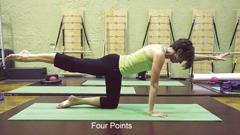
10. Four points
Reps: 2 on each side
Start in table top: Get on all fours with your arms under your shoulders and knees under your hips. Zip it up from your pubic bone to your sternum and pinch your shoulder blades together slightly so you get a flat back. Inhale, exhale then extend your right leg and left arm. Hold for 5 seconds. Inhale while releasing your arm and leg back to table top. Repeat, switching legs and arms.
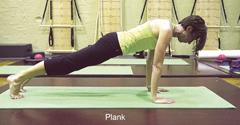
11. Plank
Reps: 1-2
Start in the table top position. Inhale, exhale, extend you right leg back and tuck your toes on the mat. Repeat on the left side. Hold in full plank for 5 seconds, following the same posture instructions as in No. 10.
12. Plank with rocking
Reps: 2
Get into the plank position described in No. 11. Inhale and rock forward on your toes, then exhale and rock back. Repeat.
13. Child pose stretch
Rep: 1
Start in the table top position. Spread your knees wide and bring your big toes together, letting your butt drop to your heels. With your arms out front of you, relax, hold and stretch for as long as you wish.
14. Push-ups
Reps: 5-10
Get into the plank position. Drop down for three seconds and push up for one second. Remember to lead with your chest, not your pelvis. If a full plank compromises your form, bring it down to your knees.
* Workout by Allison Holloran.
* Carol Seavey is the editor of Live Well Wyoming. Contact her at 307-266-0544 or carol.seavey@trib.com. Read her blog at tritown.trib.com/CarolSeavey/blog.


