


The Bulge wasn’t the worst of it.
In the Ardennes Forest, near a little Belgian town called Losheimergraben on the Siegfried Line, Jim Norton dug in with the 99th Infantry Division. Mostly, the men were doing patrols, fighting cold weather and trench foot, but everything was quiet.
“Nobody expected what was coming,” Norton said.
War was bad enough. But for Norton, the toughest part came after the Battle of the Bulge, after he was shot through the right leg and captured.
For four months he fought to survive inside a German prisoner of war hospital under brutal conditions.
In a way, he was never intended to end up where he did.
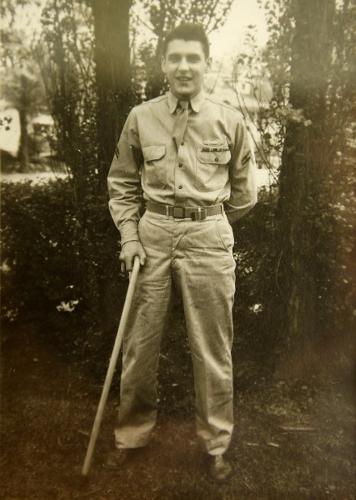
Norton was a senior in high school when the Army came around. He went through a series of exams, physical and intellectual, scoring high enough to qualify for the Army Specialized Training Program, ASTP.
People are also reading…
“The idea was to take 100,000 of the brightest draftees and offer to put them through college if they opted for the Army,” he said.
Norton signed a contract that made him a private for two years. He’d get Army pay, but he’d go to school.
D-Day causalities left a shortage of American soldiers in Europe. When he was six months in as a student at Baylor University in Waco, Texas, Norton was called outside for an announcement: The Army was eliminating ASTP.
“So they had 100,000 of us who were living the life of Riley and we were now soldier infantrymen,” Norton said. “So I went from college fraternity house to a ship, an old clunker, to England as a replacement.”
At age 20, Norton had no idea where he was, that he was protecting part of an 80-mile front. When artillery first fired, he thought it was a local fight. It was only in the POW hospital later, listening to the radio, he heard about the Battle of the Bulge.
Artillery fire lasted for an hour and a half. Norton had been freezing inside his foxhole when it started in the early morning of Dec. 16, 1944.
When the firing let up, Norton knew what was coming. The Germans followed their artillery with infantry and tanks.
The Americans held off in a firefight for most of the day. Finally, they were outgunned and outmanned. In the late afternoon, Norton got shot.
Two Americans found a wagon and pulled Norton inside, following a line of thousands of German tanks and infantry. A German doctor at a first aid station cleaned his wound and bandaged it.
Norton has no recollection of the next two days. Somehow he ended up at a prisoner of war hospital in Siegburg, Germany, about 30 miles from where he fought. A 13th century Benedictine monastery overlooked the town from a hill. Below, Norton lived inside barracks alongside other Americans, Russians, French and English.
The hospital had no doctor. A Russian man who claimed to be a medic cared for the wounded.
“His whole medicine kit consisted of little red pills, which would do everything in the world he claimed,” Norton said.
Bone fragments started separating from Norton’s ankle bone. He got an infection and ran fevers. Without real medical treatment, “too many people were dying of their wounds.”
Typhus created its own life under the bad conditions. The American soldiers had received typhus shots and were immune, but others in the hospital weren’t and died because of it. At night, Norton remembers, he picked ticks out of the seams of his clothes.
Even inside, the men could feel the bitter German winter. Each person had one thin blanket and a straw mattress.
Meals consisted of one cup of watery cabbage soup a day. The men were all close to starvation, Norton said. He went into the war weighing a healthy 145 pounds. He left weighing 110.
Over the radio and through the German guards, the men heard about the war raging outside their windows.
“We knew that we were going to win the war, and we knew that eventually we would be liberated if we could survive,” Norton said.
“That was the goal, to survive.”
But there was one problem. Siegburg sat in the part of Germany that produced tanks and arms. It was a target for bombings, guarded by anti-aircraft guns.
Every day, Norton could hear the American bombers from his barracks. They’d fly over and bomb nearby Cologne. Then came fighter planes in pairs. The first dropped down low to strafe, sometimes near Norton’s barracks. The second fighter plane would follow, engines screaming, and drop a bomb. One hit so hard Norton said it seemed like he lost his hearing for a week.
“We were cheering for our own people on one hand and praying they wouldn’t hit us on the other,” he said.
In the final 10 days, artillery could be heard. Guards loaded the prisoners into trucks and drove east to Waldbröl, Germany. The prisoners watched as the German tanks pulled out and Americans came in.
“We knew we made it,” Norton said.
After the Bulge, Norton’s parents received a telegram stating he was missing in action. It wasn’t until he wrote them from a hospital in Paris that they knew he survived.
Norton was cleaned, deloused and given a new uniform. His old clothes, which he’d worn for four months, were burned. He flew to a hospital in New Jersey and then to Springfield, Mo., where he spent five months in rehabilitation, learning to walk on his leg.
For four decades, Norton forgot all of it. Going to college at the University of Minnesota, he was three years behind. He was focused solely on catching up. Norton spent 30 years with a publishing company in Indiana, raised a family.
As the 40th anniversary of the end of the war in Europe approached, Norton noticed more books were being published. He got interested and started reading.
His kids didn’t know anything about his service. He never talked about it. Norton decided to go back, retrace his steps.
So many years later, returning held no emotion for Norton. To him, it was history.
“To see those huge forests and the Siegfried Line and say, ‘My God, I was there,’ ... that was fun,” he said. “It was just curiosity.”
He traveled backward, from the town where he was liberated to the site of the POW hospital back to the forest and Losheimergraben, where he had been shot.
In Siegburg, Germany, the Benedictine monastery still stood watch over the town. But the barracks where he had shivered and starved were gone.
In their place was a parking lot.


