


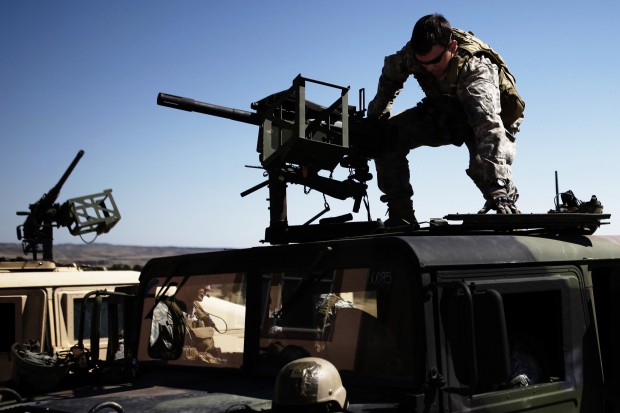
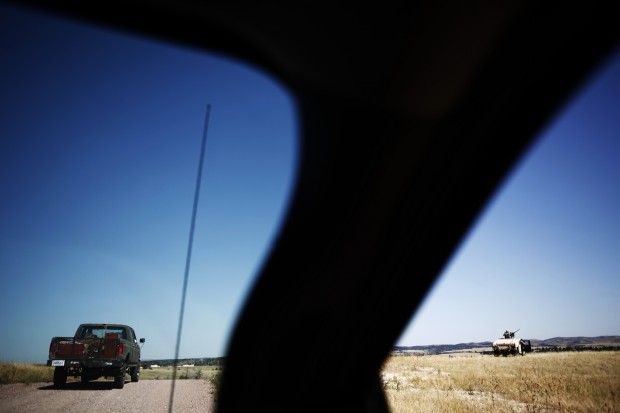
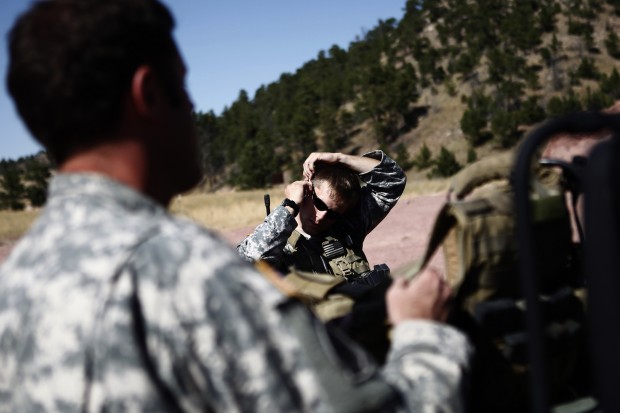
CAMP GUERNSEY — The special forces soldiers in the camouflage Humvee spot a possible roadside bomb and know they could have only seconds to escape.
The driver veers the vehicle off the gravel road and away from the blast zone. The soldier manning the grenade launcher atop the Humvee ducks into the vehicle to avoid the explosion.
The remote-control bomb explodes, shooting a poof of white powder dozens of feet into the air.
There was no fire or shrapnel.
This was training at Wyoming’s Camp Guernsey, after all, not a dangerous road in Afghanistan.
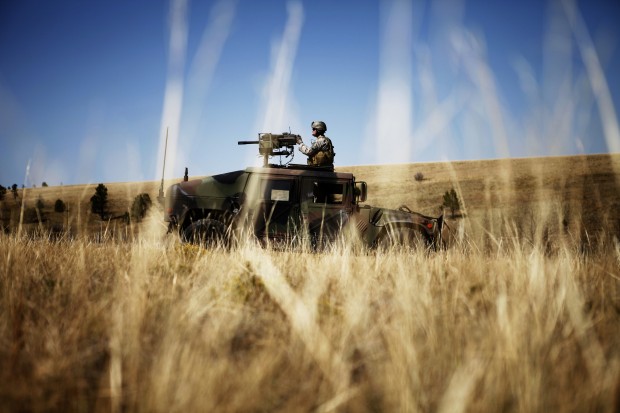
However, for troops training at the camp, such as the 5th Special Forces Group (Airborne) in the Humvee, it can be difficult to tell the differences between Wyoming’s deep valleys and craggy hilltops and those in Afghanistan.
People are also reading…
Wyoming’s landscape is considered a key feature of the camp, a joint training center that has grown in size and and use since the Sept. 11, 2001 terrorist attacks and the start of the wars in Iraq and Afghanistan.
“We meet the terrain that the special forces like here at Camp Guernsey,” said post operations officer Maj. Terry Jenkins of the Wyoming Army National Guard. “They love this terrain because it replicates Afghanistan so well.”
Training facility
Camp Guernsey, located just outside the southeastern Wyoming town of the same name, was once a relatively sleepy National Guard training center without even a chain-link fence around it.
Now, it’s a secured site used by myriad military units, with AC-130 gunships running overhead fire support missions and large cargo aircraft dropping in to practice tactical landings on the camp’s updated and strengthened air strip.
The camp also hosts a training and experiment center for unmanned vehicles, a mock village for urban combat training, parachute drop zones, numerous weapons ranges including those for bomb runs and artillery shots, and other specialized training areas.
Many of those additions came in the years following Sept. 11, 2001, as camp leaders eyed developments in Iraq and Afghanistan and listened to the training needs of military units headed into combat.
“We needed to improve the infrastructure, we had to improve the ranges, we had to improve the manning and the assets that were going to facilitate that training,” Jenkins said.
But some things can’t get close enough to actual conditions soldiers are likely to face. Master Sgt. Mark Wilson, the camp’s top enlisted man and the noncommissioned officer in charge, said there have been eight vehicle rollovers at the camp since he arrived to his post in April.
It’s an expected problem, as young drivers who are likely unfamiliar with rough gravel roads receive lessons best learned in training. Yet even these roads don’t quite match the shoddy conditions of the roads in Afghanistan, said Wilson, who has served in that country.
“We just can’t make them bad enough to closely approximate Afghanistan,” he said.
Camp’s popularity grows
Camp Guernsey’s joint training center has seen a more than a ten-fold increase in use, by units of all stripes including National Guard and active-duty troops, special operations units, Marines and law enforcement, Jenkins said.
Jenkins added that news of the camp’s training capabilities has spread through word of mouth, some advertising and in response to the needs of the military and law-enforcement services.
“We’re starting to get a lot of people show up,” he said. “Sometimes we can’t handle the throughput requests, because we just got too many people asking to come.”
The camp opened in the 1930s. Today it has about 125 square miles of terrain over which vehicles and troops maneuver. Jenkins estimated the area has doubled in size from the mid-1980s.
Jenkins also said the camp’s setting is desirable to special operations troops.
“We don’t have the urban sprawl, we don’t have the prying eyes that some of the bigger bases and posts have,” he said. “The guys love it, they love to be able to go off and play on their own.”
Camp mirrors military
The changes at Camp Guernsey mirror the changes in the makeup of the U.S. military sent overseas, said garrison commander Col. Richard Knowlton. In the past, National Guard units seldom were called up for duty, or if they were, they likely wouldn’t be deployed overseas.
Since the start of the Afghanistan and Iraq wars, guard units have been expected to join their active-duty comrades in the war zones as equal partners. As a result, places where guard units train, including Camp Guernsey, needed to improve.
“We had to step up in facilities and ranges and everything we do so that we could enable those guard commanders to bring their soldiers to the fight fully manned, equipped and trained, and ready to go right in and do their mission,” Knowlton said.
The camp’s multitude of customers, as its leadership calls them, fits with what Jenkins sees as a military transformed by the years and battles of the post-Sept. 11 era.
“The global war on terrorism has probably brought the military community together like it was years ago, that our generation hasn’t gotten to see before,” Jenkins said. “Not that I want us to be in war, but some of the residuals from war have made our military better. It really has.”
Reach Jeremy Fugleberg at 307-266-0623 or jeremy.fugleberg@trib.com. Read his blog at http://trib.com/news/opinion/blogs/boom/ and follow him on Twitter: @jerenegy.


