


No butter. No fat. No salt. No taste.
Cooking without fats and salt can result in bland, tasteless meals.
But for the those who need to watch their fat or salt intake, there is hope: Cooking with herbs enhances the flavor of foods, so you won't need to add fats or salt to have a delicious dinner, according to the American Dietetic Association.
"You can season things with herbs and a lot less salt and actually eat a lot healthier," said Eli Dicklich, who owns Herbadashery Shoppe and Gardens in Casper with his wife, Barb. The Herbadashery greenhouse has a large selection of cooking herbs, many of which are used in the company's catering business.
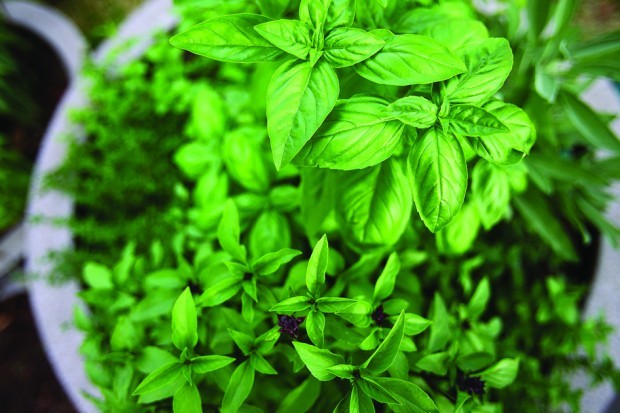
Fresh herbs have a richer, more condensed flavor than those sitting in jars over the stove. While it can be difficult to find unspoiled, fresh herbs at the supermarket, it's easy to grow them yourself.
People are also reading…
"We are in a high plains desert, so it's dry, the soil is really lousy and herbs grow like weeds," Dicklich said.
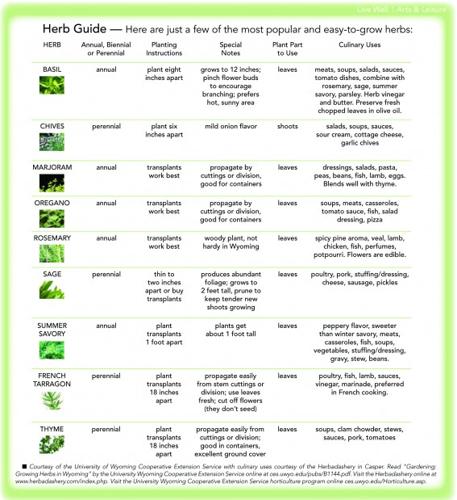
Herbs are grown for their shoots, leaves or seeds, and some are grown for more than one. For example, coriander seeds are coriander, but the leaves are cilantro, a parsley-like herb used in Hispanic dishes. Plant separate plants for different uses, as the cultivation of the leaves and seeds may conflict.
Seed herbs can be difficult to grow and cultivate, so it's best for beginners to start with leaves and shoots.
Most herbs are easily grown from transfers, which should be planted after Memorial Day.
"Your tender type plants, you don't want to put out before Memorial Day," Dicklich said.
Look for herb plants at your local greenhouse, and be sure to ask your gardener details about planting and growing the herbs you choose, as not all herbs are the same.
Planting
The best way to plant an herb garden is in a raised bed, Dicklich said. He suggests building an 8-foot by 2-foot garden so you can reach all of the plants. Then, put nails in the frame every foot and wind string across them to create a grid. Each square foot can hold a different herb.
Herbs can be planted in pots, but you have to be careful to group like plants.
"A lot of herbs do really well in containers," said Karen Panter, a certified professional horticulturist and horticulture specialist with the University of Wyoming Cooperative Extension Service.
It's best to plant just one plant in each container, she said, so you can adjust the amount of sunlight and water each plant receives.
Most herbs need plenty of sun, so plant them where they will receive sunlight most of the day.
Your herbs won't grow without fresh soil, though.
"Our native soil is not conducive for them, so what you have to do is amend it with organic matter," Panter said.
- Add two inches of organic compost to the garden and till it to the depth of about six inches, Panter suggests.
- Or nix all the native soil in favor of the store-bought kind. Dicklich says a mix of 1/3 coarse vermiculite, 1/3 compost and 1/3 peat moss works well.
- Another option is to mix three parts Sunshine Mix with one part sand. This mix drains well, Dicklich said.
- When using fertilizer, Dicklich suggests using no more than half the dilution for regular plants.
Also, consider using organic mulch such as bark.
"Mulching cuts down on weed problems and keeps the soil moisture where it needs to be," Panter said.
Whatever you use, it should be herbicide- and pesticide-free.
Growing
Herbs require watering during the growing season, and even moisture is typically best, Panter said.
"If they're going to be out in an open area that's sunny without a wind break, they're gonna dry out much quicker," Panter said.
Be cautious of over watering, though.
Before watering herbs, dig four to six inches into the nearby soil. If it is moist, the plant does not need to be watered.
For potted herbs, Dicklich suggests tipping the plant out into your hand and looking at the roots. Again, if it's moist, it doesn't need watering.
If the herbs are going to be eaten, don't use herbicides or pesticides. Weed by hand, and try one of Dicklich's poison-free sprays for pest control:
- Dilute about one ounce of Pure Castile soap in one gallon of water and apply to plants. "This kind of stuff is safe for you, safe for the plant, and it'll knock 'em down," he said.
- Mix one gallon water, one tablespoon Liquid Dial Soap, one tablespoon soy oil and one cup of ammonia in a sprayer and apply to plants.
Cultivating
Pick leafy herbs throughout the growing season. In fact, picking leaves -- also called pinching -- is good for an herb plant.
"The more you pick, the better it grows," Dicklich said.
Wash and use fresh herbs shortly after picking them. If there are too many to use at once, try freezing or drying them.
- To freeze herbs, blend them with water in a blender, pour the mixture into an ice cube tray and freeze it, Dicklich suggests. Pop out cubes to use in your favorite sauces.
- To dry herbs, the University of Wyoming Cooperative Extension Service suggests cutting the stems in the early morning, before the flowers open. Tie the herbs together at the cut ends and hang them upside-down in an airy, well-ventilated, dark area. When the leaves are crispy, strip them off and store them in air-tight containers away from direct sunlight.
Carol Seavey is editor of Live Well Wyoming. She kills everything she plants. Contact her at carol.seavey@trib.com or 307-277-7361.
More online
Read "Gardening: Growing Herbs in Wyoming" by the University Wyoming Cooperative Extension Service online at http://ces.uwyo.edu/pubs/B1144.pdf.
Visit the Herbadashery online at http://www.herbadashery.com/index.php.
Visit the University Wyoming Cooperative Extension Service horticulture program online http://ces.uwyo.edu/Horticulture.asp.


