


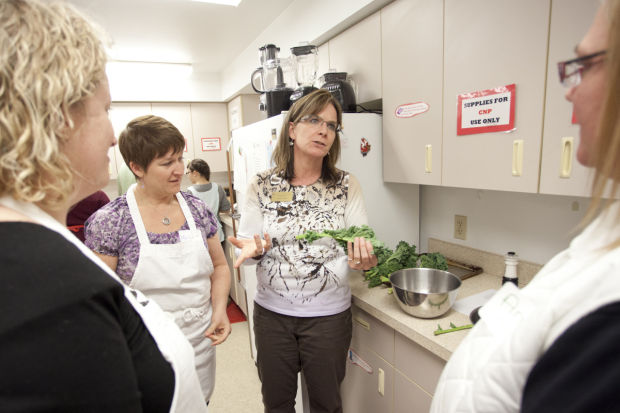


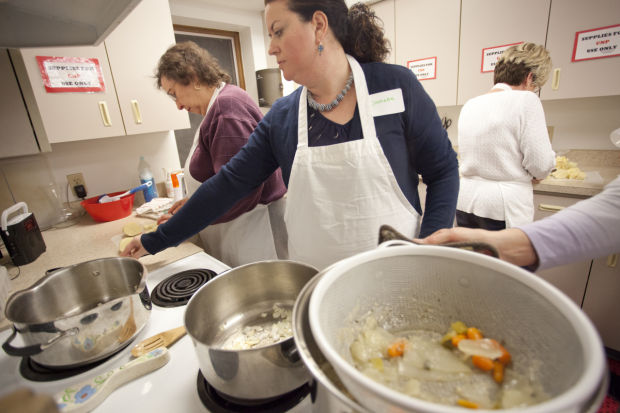



“Who’s the chopper?” a woman asked the apron-clad women gathered in one of three corner kitchens.
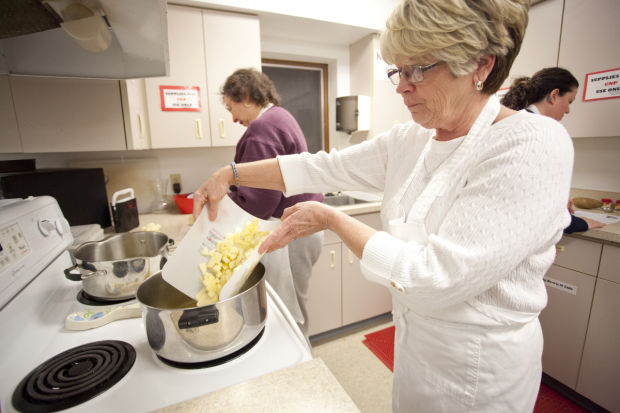
Within minutes they were peeling and chopping potatoes and onions and tossing them into pots of soup that were simmering on a stove.
In another corner, a mother-daughter team opened a can of pumpkin puree with an electric can opener and dumped the contents into a bowl.
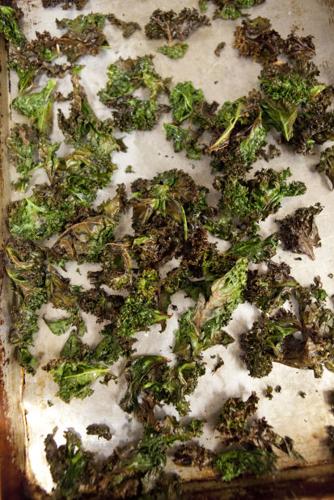
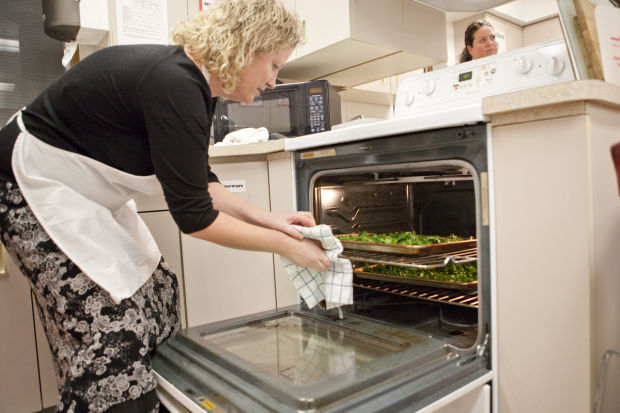
As the oven is preheated in corner No. 3, two women tore washed kale into bite-sized pieces and tossed them in a bowl with a bit of olive oil.
The groups made cream of potato soup, whole wheat pumpkin bread and kale chips from scratch during a Real Food Workshop at the University of Wyoming Extension office is Casper. The five-week course is designed to help people reduce or eliminate processed foods and sugar from their diets.
People are also reading…
The health benefits of eating fewer process foods differs from person to person. Many who adopt the lifestyle report a well-functioning digestive system, and others may experience more energy or better sleep, said Karla Case, Real Food Workshop instructor and a registered dietitian with the University of Wyoming Extension in Casper.
Cara Mesecher, of Casper, attended the Real Food Workshop to learn to how to cook and to improve her health.
“I have a lot of chronic health problems, and I hope that if I can move toward whole foods, I can improve that,” she said.
In the weekly class, participants not only learn why processed foods and sugar should be avoided, but how to plan meals, shop and cook natural foods. The first half of the class is held in a classroom setting and the latter half is hands-on in the kitchen. Participants also receive a copy of the book, “Food Rules: An Eater’s Manual” by Michael Pollan. The class costs $35 and will be offered again in March.
“Eighty percent of our diets are manufactured and very little is whole foods,” Case said. “It’s important to go back to basics, and it’s easy to do.”
Processed foods are any edibles that are altered from their original state. Simply slicing, cooking, canning or freezing food alters it, but the real concern is packaged foods, Case said. Oftentimes, foods are packaged with added ingredients to improve flavor, texture, convenience or shelf life.
While some of these added ingredients are reviewed and approved by the U.S. Food and Drug Administration, others are not. When there is a consensus among qualified experts that the substance is safe under the conditions of it’s intended use, ingredients are labeled Generally Recognized As Safe by the FDA. These ingredients are not subject to premarket approval and review by the FDA.
“To me, that’s kind of saying that we think it’s safe, but you’re taking a risk,” Case said. “There’s is so much we don’t know about additives in our foods, and I don’t think that we should be feeding them to our families or children.”
While some additives are necessary or harmless, there is limited information on how additives affect our bodies. However, packaged food is known to contain an abundance of sodium, fat and sugar.
SODIUM: Eating too much sodium can lead to increased blood pressure, which contributes to heart disease and stroke. According to the Centers for Disease Control, more than 75 percent of the sodium Americans consume comes from processed and restaurant foods. Very little comes from salting food at the dinner table or when cooking.
FAT: Trans fat can increase one’s risk of coronary heart disease, which may lead to heart attack, according to the FDA. The FDA is working to eliminate added trans fat in packaged food. Until then, keep in mind that companies can say a product has zero trans fats if it contains less than 0.5 grams of trans fat per serving. Therefore, trans fats are easier to spot in the ingredient list: If partially hydrogenated oil is listed as an ingredient, the food may contain a small amount of trans fat, according to the FDA.
SUGAR: Sugar has no nutritional benefit, and the extra calories may lead to weight gain, according to The American Heart Association. The average adult eats 22 teaspoons of added sugar a day, in addition to natural sugar from fruit and milk. The American Heart Association recommends limiting added sugars to 9.5 teaspoons a day. Added sugars go by a variety of names, such as maltose, brown sugar, corn syrup, cane sugar, honey, high-fructose corn syrup and fruit juice concentrate, and they aren’t just in sweets. Sugars are also used in bread, jarred pasta sauce, cereal and other foods.
“High-fructose corn syrup tends to be in the majority of foods that we eat,” Case said. “Research behind that is showing that because the liver breaks it down, high-fructose corn syrup in excess can cause some problems in the liver.”
A diet rich in real food and low in processed foods is high in nutrients, such as fiber, and low in added sugar, fat and sodium.
“By eating just whole food or real foods, you’re going to be getting the nutrients that your body needs in the way that it needs them,” Case said.
At the end of the class, participants shared their creations and each person got a taste. Several of the women were surprised by how good the food tasted and how easy it was to make.
“We’re learning that it’s not that much harder and it doesn’t take that much more time,” said Stacey Moore, who attended the class with her daughter, Anna Burton.
Carol Seavey is editor of Live Well Wyoming magazine, which is published six times a year by the Casper Star-Tribune. Contact her at 307-266-0544 or carol.seavey@trib.com. Follow her on twitter at Carol_Seavey. Live Well Wyoming is on Facebook at www.facebook.com/LiveWellWyoming.


