


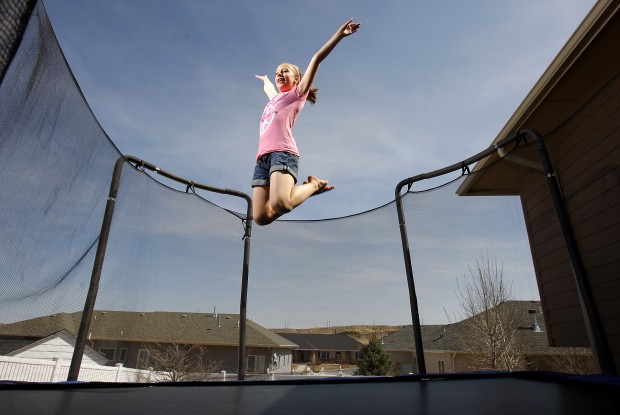
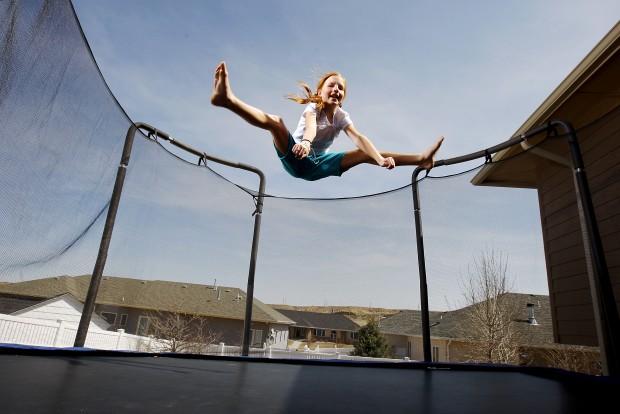
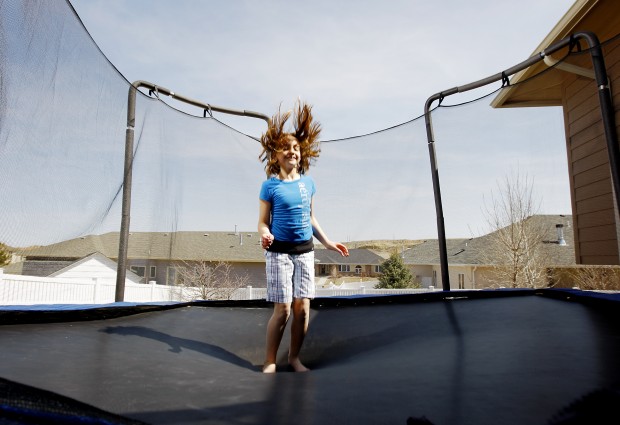
One day last summer, 8-year-old Audrey Mitchell ran to her room and shut the door. She didn't want her father, Dr. Matt Mitchell, to see the bloody nose she had gotten while playing crack the egg on a neighbor's trampoline.
The Casper girl wanted a trampoline of her own, but her father was against it. And this wouldn't help.
Mitchell, an orthopaedic surgeon at Casper Orthopaedics Associates, sees about one patient each week in the summer for trampoline injuries.
After weighing the risks and benefits of owning a backyard trampoline, the Mitchells decided against it.
In 2003, hospital emergency rooms, doctors' offices and clinics treated 211,646 trampoline injuries in children under age 19, according to the American Academy of Orthopaedic Surgeons.
The most common trampoline injuries are sprains and fractures, which usually result from a fall on the trampoline, according to the American Academy of Orthopaedic Surgeons.
People are also reading…
Severe injuries are rare, but can result in paralysis and even death. From 1990 to 2000, 11 trampoline related deaths were reported to the U.S. Consumer Product Safety Commission.
The American Academy of Pediatrics says no one should use backyard trampolines, as adult supervision cannot adequately prevent injuries. Trampolines should only be used in supervised training programs for gymnastics, diving and other competitive sports, the academy says.
Despite this recommendation, backyard trampoline sales continue to rise. The International Trampoline Industry Association estimated that 640,000 backyard trampolines were sold in 1998. That's a 350 percent increase from 1989.
"As the number keeps on increasing, we're just going to get more and more injuries," Mitchell said.
Then, there's the liability.
Backyard trampolines are generally considered attractive nuisances.
"If somebody hurts themselves, it's typically going to be considered the homeowner's responsibility," said Bret Drury of Farmers Insurance Group in Casper.
Some insurance companies may have exclusions for trampolines, some require a fence to be built around trampolines to prevent access by neighborhood children or passers-by, and others may not cover them at all.
If you ever plan to get a trampoline, definitely check with your insurance company, Drury said.
There's little chance that people are going to stop buying trampolines. But there are some steps you can take to make summer jumping safe and fun:
- Only allow one kid on the trampoline at a time. Oftentimes, injuries occur when there are multiple jumpers because they can collide with each other or catapult one another off the trampoline.
- Prevent falls. Since the average kid can jump eight to 10 feet into the air on a trampoline, falling off a raised trampoline could result in a 13-foot fall. "Injuries do occur when they bounce off the trampoline," Mitchell said, "and that's where the severe injuries occur." Get a net, place the trampoline in an area where it's surrounded by a soft surface or set the trampoline in the ground.
- Check the trampoline regularly for safety conditions. Make sure the supporting bars and mat are not damaged and that the springs are covered with protective padding.
- Supervise jumpers to enforce proper use. Especially watch young kids, Mitchell said. Place the trampoline somewhere in the yard where you can see it from the house.
- Avoid somersaults and other high-risk maneuvers. Landing incorrectly from a somersault can result in paralysis or death, according to the U.S. Consumer Product Safety Commission.
- Remove the ladder. Trampolines haven't been sold with ladders since 1999. If you have one, take it off to prevent young children from accessing the trampoline unsupervised. Don't allow children under age six on trampolines.
- Secure the trampoline in place. Heavy winds can blow trampolines over and damage property.
Carol Seavey is editor of Live Well Wyoming. Contact her at 307-266-0544 or carol.seavey@trib.com.


