


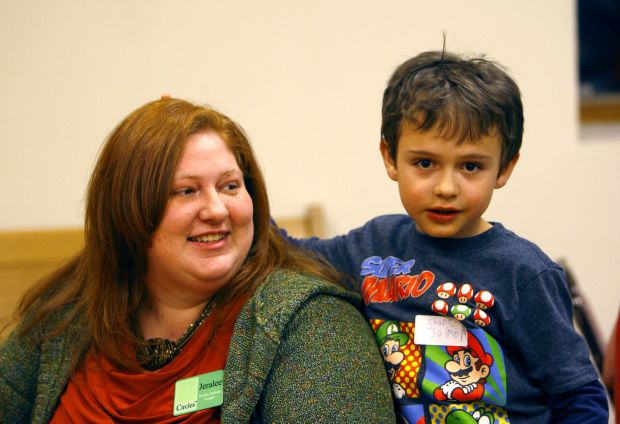
Jeralee Salmon didn’t think she was like other people who were living in poverty, but growing up in Kalamazoo, Mich., in a single-parent home, poverty was all she knew.
Her clothes all came from a thrift store, because her mother couldn’t afford to buy them new. It was dangerous to go outside because there was a motorcycle gang in her neighborhood.
“I really felt like there was no possible way I was going to move past or beyond that,” she said.
It wasn’t until she studied poverty in a social work class at the University of Wyoming at Casper College, that she realized her struggles were very much like others living in poverty.
She settled in Casper after a summer job brought her to Yellowstone National Park about
10 years ago. She started taking college classes after she was married and had a child. When she divorced after five years of marriage, finishing college became even more important.
People are also reading…
“I could see that the only way I’d be able to support my family without welfare [was to finish],” Salmon said.
In February 2013, Salmon was one of the six people in Casper to complete Getting Ahead, a program offered by Circles Wyoming, a nonprofit organization that offers education and networking opportunities to people who want to get out of poverty and become self-sufficient. The class typically consists of a 12-to-15-week course that meets once a week. After completing the course, participants are paired with mentors in the community who are called allies.
“I think there’s kind of a misconception that people are living off the government,” said Chad Werner, Circles Wyoming state coordinator and Circles Cheyenne community coordinator. “I think there’s a desire of people to move forward, and having a couple extra brains and resources is very helpful.”
Circles was developed in 2000 by Circles USA, which is currently based in Albuquerque, N.M. The program is designed to raise people out of poverty with the help of individual people, organizations, communities and government. It combines best practices in several disciplines such as community organizing, case management, grassroots leadership, Specific Measurable Attainable Realistic Timely goal setting, financial literacy, mentoring, peer-to-peer counseling and child development.
According to its website, the philosophy behind Circles is that government and social services alone cannot eradicate poverty.
“It puts responsibility back on the individual, versus policy or government driving resources that are needed,” Werner said. “It empowers individuals versus enabling them.”
Today, there are more than 1,000 Circles chapters in 70 communities in 21 states and parts of Canada.
In 2010, 9.8 percent of Wyomingites lived at or below the federal poverty line, according to the U.S. Census Bureau. The Wyoming branch of Circles was established in 2008 with a chapter in Cheyenne. The Riverton and Casper chapters held their first classes in the fall of 2012.
Circles Wyoming is funded by the Wyoming Department of Workforce Services and organizations in the respective chapter communities, such as community foundations, churches, business groups, local governments and community colleges.
Salmon graduated with a Bachelor of Arts in Social Work from the University of Wyoming at Casper College last May and currently heads up the Casper chapter of Circles Wyoming as its full-time community coordinator.
On a recent Tuesday evening, she greeted families as they came to a meeting at First United Methodist Church in Casper and invited them to fill their plates with spaghetti and salad donated by Olive Garden.
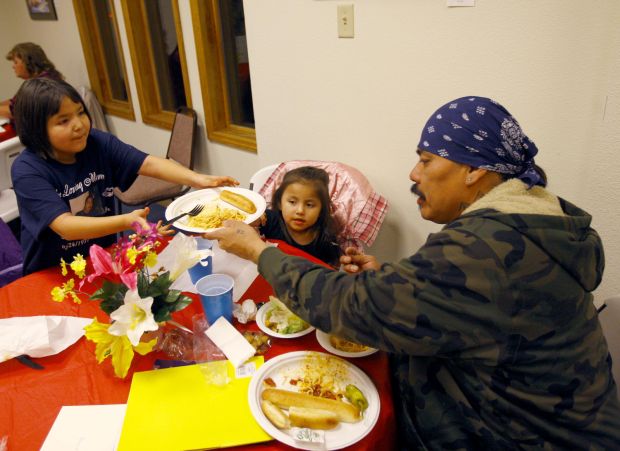
John Shotgun Jr. sat at a round table with his two daughters: Lemia, 3, and Luree, 8. The 43-year-old Casper man has been in and out of poverty his whole life. He has a good job working construction now, and says he has never earned enough to file taxes before.
“I’m just tired of living check to check,” he said. “I’m done with it, and this class is really helping.”
Shotgun spoke of the life he left behind, pausing every now and then to carefully wipe the red sauce from Lemia’s face as she slurped up spaghetti.
He grew up in East Los Angeles, where his involvement in gangs and drug use landed him in prison off and on, he said. He has four other children, but he isn’t in their lives. His most recent stint in prison ended less than two years ago, and he’s been sober from alcohol and drugs for a year.
“It’s a little late, but I’m finally being a father to my kids,” Shotgun said. “I’m doing really good, and it’s a positive in my life.”
Unlike similar programs Shotgun has done, Circles Casper is giving him the tools and resources he needs to reach his goals.
ABOUT THE CLASS
“Do you have a ‘new and good’?” Salmon asked.
The families in the Getting Ahead class with Circles Casper had cleaned up after dinner and were seated at round, white tables. Salmon went around the room and asked each person to share something good or new that happened to him or her that week. It’s all part of the positive atmosphere of Circles Casper.
The class meets for two hours once a week for 15 weeks. Each meeting starts with a free meal for the families, then after the “new and good”s, the children are off to child care, which is provided. Then, the adults can concentrate on their studies, many of which come from the book, ”Getting Ahead in a Just-Gettin’-By World: Building Your Resources for a Better Life,” by Philip E. Devol.
Topics are tailored to the needs of the group, and may include life skills such as budgeting, how to write a resume, maneuvering social services, how people get into poverty, where emergency services can be found, health care and more.
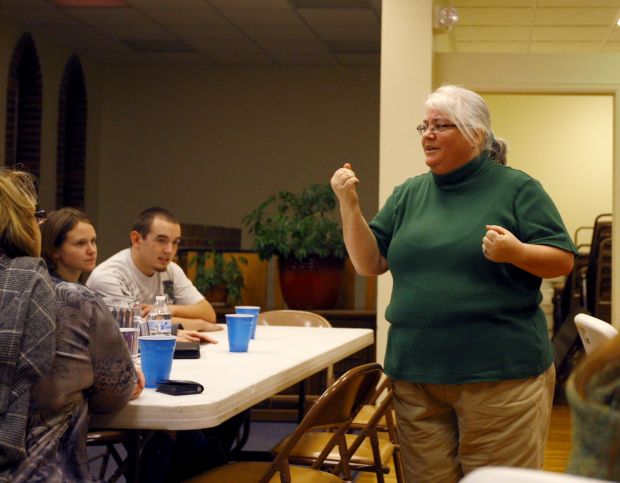
About once a month, there is a speaker. On this particular evening, Linda Crowder — owner of Focus Forward career and business coaching in Casper — gave a presentation on goals. The animated woman talked about setting goals, overcoming fears, and tactics for reaching goals, all along engaging the participants with questions and discussion.
“You can reach any goal you want, as long as you’re willing to do the work,” Crowder said.
For the five participants in Circles Casper, the goal is similar: get out or stay out of poverty.
Tiana Peters, of Casper, became a single mother to her now 4-year-old son after her husband went to prison. She wants to straighten out her life for her child.
“I grew up low-income and my parents never taught me how to do all this stuff, so I want to teach my son,” Peters said.
The program also emphasizes camaraderie, which is not lost on Laurie Scott, of Casper.
“I like meeting new people and just learning about everybody elses’ experiences and trying to help each other,” she said.
Nationally, 75 percent of those in Circles graduate and 80 percent report an increase in household income, according to Werner.
Once they have graduated, participants become Circle leaders — leaders of their own circles or the heads of their households — and are assigned two to four allies.
ALLIES
Circles emphasizes networking across socioeconomic lines, starting with allies.
“If a person in poverty is surrounded only by people in poverty, that’s where they are getting their advice,” Salmon said.
Allies are people from middle-to-high income who volunteer to mentor Circles leaders for about four to 10 hours a month for at least six months. They are typically people who are well-connected in the community and have resources, Werner said.
Allies complete a full day of training using a book — “Bridges of Poverty: Strategies for Professionals and Communities,” by Ruby K. Payne, Terie Dreussi Smith and Philip E. Devol — to better communicate with their students and learn the ground rules, such as don’t give the person money or be a rescuer.
“The ally’s job is really just to be a friend and pool their resources so the person can get ahead in life,” Werner said.
The first Casper Circles class did not have allies, but Salmon had an informal mentor who encouraged her to finish college.
Those who graduate from Getting Ahead and become Circle leaders continue to attend weekly meetings, but in a different format. Rather than studying from a book, there is a theme for each week:
1. Goal night: Circle leaders get together with their allies to discuss their goals and develop relationships.
2. Peer night: Circle leaders and allies meet separately, so they can discuss their experiences with their peers.
3: Topic night: A speaker from the community gives a presentation on a topic of interest. This meeting is open to the public.
4: Guiding coalition: Each Circle leader is on an organizational team to help Circles Casper move forward, along with others in the community. The teams meet to discuss their goals and projects.
5: Big view: If there is a fifth week in the month, it is used as an opportunity to discuss local, statewide or national barriers and work toward fixing them.
Each participant’s situation is re-evaluated after six months. If they are ready to leave the nest, they no longer attend Circles meetings. Otherwise, they continue the program and are re-evaluated after another six months. It sometimes takes a year or more for Circle leaders to get on their feet, Werner said.
Just because the program formally ends, doesn’t mean the relationships do. Circle leaders and allies often form lasting connections.
“They become friends. So, when you’re moving through life, you have some help,” Werner said. “You don’t have to be in isolation. There are people who care and want to see you thrive.”
Carol Seavey is editor of Live Well Wyoming magazine, which is published six times a year by the Casper Star-Tribune. Contact her at 307-266-0544 or carol.seavey@trib.com. Follow her on twitter at Carol_Seavey. Live Well Wyoming is on Facebook at www.facebook.com/LiveWellWyoming.


