


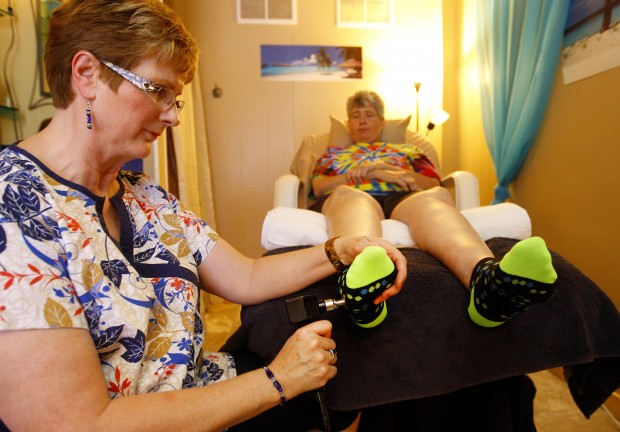
“Right hip, right knee and sciatic, please,” said Cindy Millay, as she reclined in a massage chair with her sock-covered feet hanging off the end.
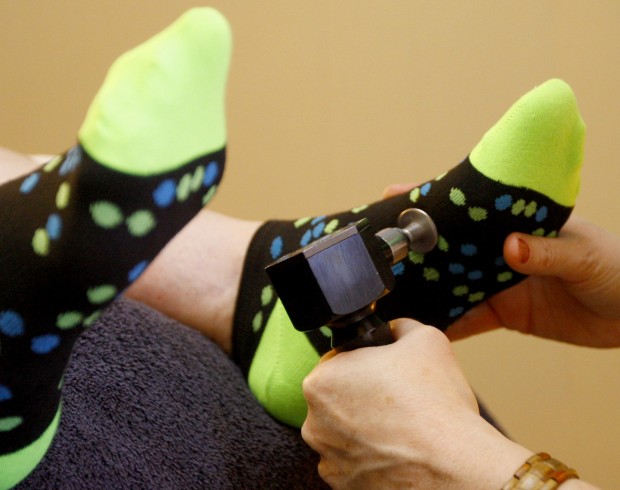
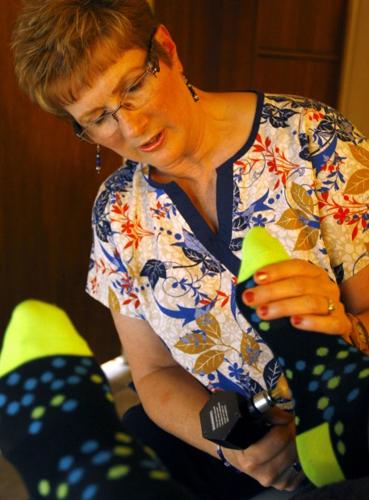
Sue LaDuke gently massaged the bottom of her foot with an electric tool, sending 4,400 tiny impacts a minute into Millay’s foot.
“That’s your sciatic,” LaDuke said.
“Yeah, it is!” Millay said.
Every Monday, Millay gets reflexology from LaDuke, of Casper, who is a certified reflexologist with the Modern Institute of Reflexology in Colorado. Millay has had unexplained joint pain for more than eight years, and working on her feet as a route salesperson aggravates it. But reflexology helps ease her pain.
“I’ll walk out of here a whole lot looser than I came in,” Millay said.
People are also reading…
ABOUT
Reflexology is a complementary therapy in which pressure is applied to nerves in the feet, hands or ears. These nerves correspond with glands, organs and other parts of the body.
“By putting pressure on the nerves, you’re sending a message to the brain,” LaDuke said. “The brain will send circulation and energy.”
Foot work dates back to ancient Egypt and China, but reflexology as we know it wasn’t introduced to the U.S. until the 1930s. At that time, Eunice Inghan of Rochester, New York traveled the nation and southern Canada teaching reflexology, according to Christine Issel, cofounder of the American Reflexology Certification Board in Grand Rapids, Mich., a nonprofit testing agency for the certification of reflexologists. Ingham is known as the mother of reflexology worldwide, and her technique is the most commonly used today, according to Issel.
The state of Wyoming does not require reflexologists to be licensed, nor do most other states.
BENEFITS
According to the American Reflexology Certification Board, reflexology improves lymphatic drainage and blood circulation, stimulates nerve pathways, and encourages muscle relaxation, which helps the body balance itself.
Some studies show that reflexology may reduce pain and psychological symptoms, such as anxiety and depression, and enhance relaxation and sleep, according to the Mayo Clinic. Other studies show that reflexology may reduce pain in cancer patients, but more research is needed.
It is not a substitute for medical treatment, but can complement traditional medicine.
“It’s a great preventive therapy,” LaDuke said. “It helps keep you in better health.”
There are no known negative side affects to reflexology, but because practitioners say it stimulates the circulatory system, those with a history of blood clots are discouraged from getting it.
Dolores Jones, of Casper, started receiving reflexology in January for pain reduction. She suffers from a birth defect that results in recurrent kidney stones. She’s had surgery to remove kidney stones at least nine times. She tries to tolerate the pain for as long as she can, so she has fewer surgeries, and her biweekly reflexology treatments help her do just that.
“I’m just very impressed how with other diet, exercise and doctors, this is just an added benefit,” Jones said.
D’Ann Miller, on the other hand, uses reflexology to reduce stress. She first tried it when LaDuke was giving a demonstration at Wyoming Medical Center, where she works as a nurse practitioner. When Miller drove home later that day, she was floored by the increased range of motion in her neck as she turned to check traffic.
Since then, she’s gotten reflexology regularly. It helps reduce her stress and she has fewer migraines.
“My general well-being is better when I have it and have it consistently,” she said.
WHAT TO EXPECT
A typical reflexology appointment is 30 or 60 minutes long. First-timers can expect to fill out a questionnaire or speak with the practitioner about their health. Then, the practitioner will usually ask if there is anything in particular that is ailing him or her. The practitioner will then begin to manipulate the feet.
While reflexology is commonly done with the hands on bare feet, LaDuke’s technique is done on socked feet using tools. She uses Dr. Riley’s Ultra Massager, a small, electric massage gun with heads of various shapes and materials.
Some people, like Millay, can feel the corresponding body part that’s being worked on at the time, but others cannot.
Results can be seen immediately in some, but it may take others a day or two. The duration of the relief also varies.
For more information, call Dye-Namic Impressions Salon in Casper at 307-234-9700.
Carol Seavey is editor of Live Well Wyoming magazine. Contact her at 307-266-0544 or carol.seavey@trib.com. Follow her on twitter at Carol_Seavey.


