
The Sleep Lab at Wyoming Medical Center in Casper isn't the clinical setting that most expect.
Each of the two rooms has a queen-sized bed with a pillow-top mattress, with colorful linens, nightstands, comfy chairs and a chest of drawers. Pictures hang on the walls -- as does a flat-screen TV -- and there's a bathroom in each room.
The rooms designed to feel as much like home as possible, according to said Dotty Stubbs, a board certified sleep technician with The Sleep Lab at Wyoming Medical Center.
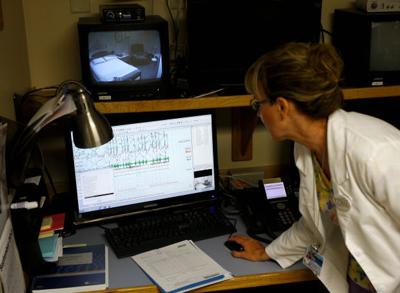
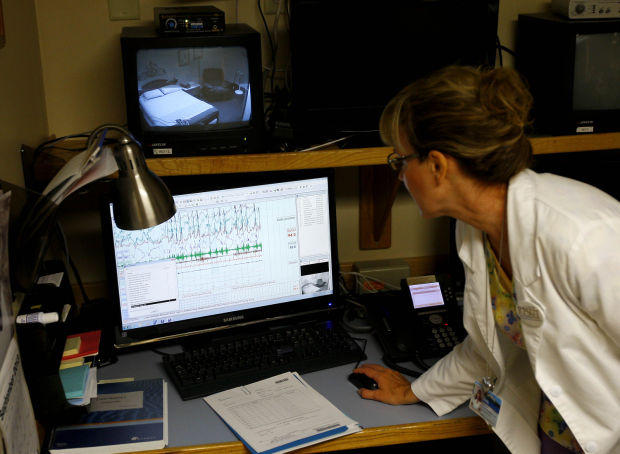
She spends overnight hours in a room adjoining the two bedrooms, carefully watching monitors and grainy video feeds.
"A lot of people are worried about somebody watching them sleep," Stubbs said. "But I'm watching the waveforms."
The Sleep Lab diagnoses a number of sleep disorders, but most patients are there to be screened for obstructive sleep apnea.
People are also reading…
Patients have to be there for a full six hours for a complete sleep study, although they don't necessarily have to be asleep the entire time.
Patients start arriving at 7:30 p.m., because it takes about 40 minutes to set up the sleep test. Twenty-nine electrodes and other pieces of equipment are strategically placed the head, torso and limbs to measure brain waves, eye movements, leg kicks, heart rate, muscle tone and breathing patterns during sleep.
Though it may appear uncomfortable, few people have trouble sleeping while wearing the equipment. They can also easily disconnect from the machines in order to use the bathroom, which is adjoined to the room.
Patients are welcome to watch TV, read or use electronics until they fall asleep.
The sleep technician monitors the data being collected as it scrolls across computer monitors. If a patient shows enough sleep events early enough in the night, a Continuous Positive Air Pressure will be put on him or her. The machines use air pressure to keep the airway open during sleep.
The patient is awakened at 5:30 a.m. and the results are evaluated by a doctor, who usually meets with patient in about a week.
Some people who are prescribed a CPAP return to The Sleep Lab for the air pressure to be set.
The Sleep Lab does about 30 to 40 sleep tests a month. Majority of those tests are to diagnose obstructive sleep apnea, and many patients are prescribed CPAPs as a result.
If you think you may have a sleep disorder, call your doctor or The Sleep Lab at 307-577-2833.
Carol Seavey is special sections editor at the Casper Star-Tribune. Contact her at 307-266-0544 or carol.seavey@trib.com. Follow her on twitter at Carol_Seavey.