


Flex your foot. Snort. Look up. Close your eyes.
With each action, a different line jumps on a computer monitor in the next room.
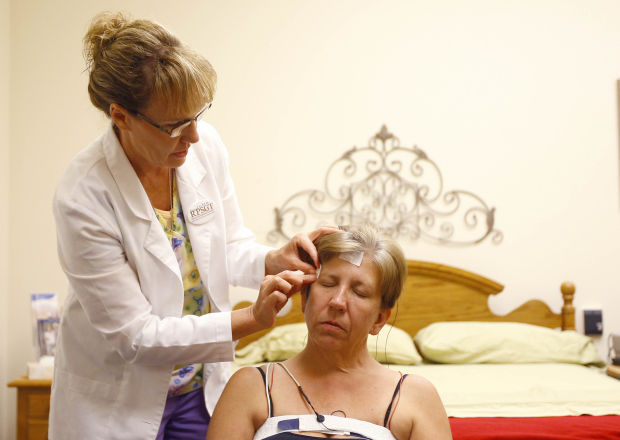
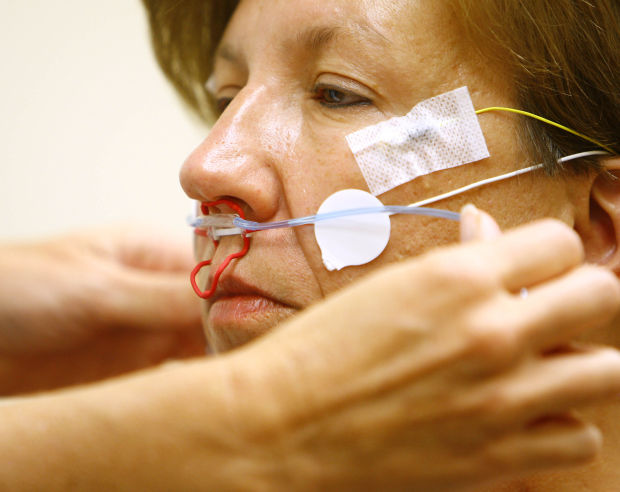
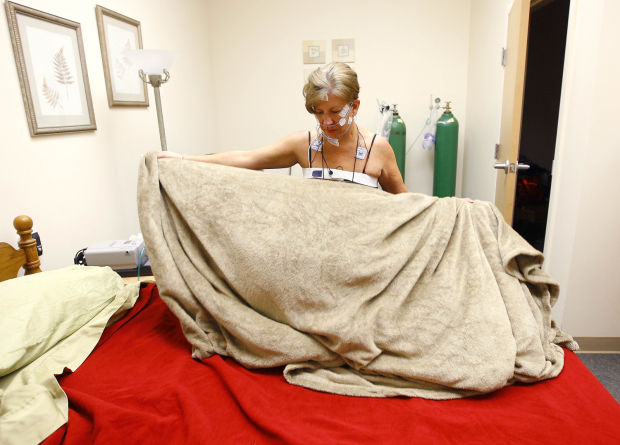
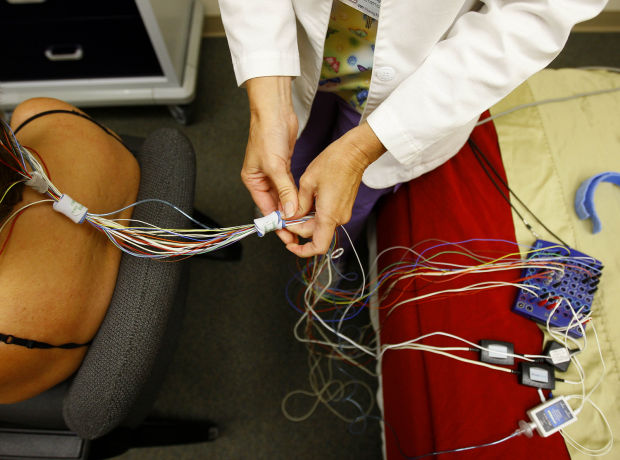
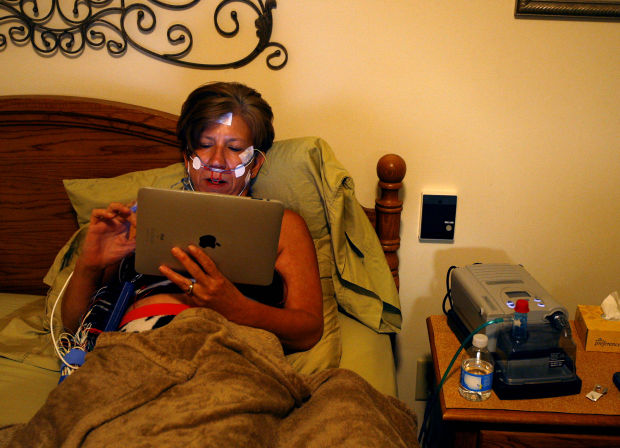
Elizabeth Harris sits in her pajamas and watches TV. Twenty-nine electrodes and other pieces of equipment are strategically placed on her head, torso and limbs to measure her vitals while she sleeps.
The Casper woman has been on oxygen since undergoing outpatient surgery and hasn’t been sleeping much. So, her doctor recommended she undergo a sleep test at The Sleep Lab at Wyoming Medical Center in Casper, where she is also an employee.
Wyoming Medical Center recently launched a new initiative to diagnose obstructive sleep apnea. It’s a condition in which the airway collapses or becomes blocked during sleep, causing pauses in breathing that can last a few seconds to a minute. This can occur hundreds of times during the night, causing poor quality sleep and reducing the amount of oxygen in the blood.
People are also reading…
“Your oxygen level drops and, over time, you’ve got increased risk for traffic accidents, heart disease, diabetes, stroke, reflux disease and congestive heart failure,” said Gail Parker, manager of respiratory care at Wyoming Medical Center. “It has significant morbidity when it goes untreated. The average age of length of life is 58 years old if left untreated.”
People who have diabetes or are obese who are treated for obstructed sleep apnea can also expect improvements.
The initiative is specifically targeted at surgical patients, because those who have undiagnosed obstructive sleep apnea have an increased risk of complications, longer post-surgical hospital stays and increased risk of death, Parker said.
“If somebody has undetected sleep apnea and goes to sedation, their oxygen saturation could drop dangerously low,” said Dr. Ammar Hussieno, a pulmonologist at Casper Pulmonary.
The program is expected to roll out to all patients admitted to Wyoming Medical Center within a year.
ABOUT
Obstructive sleep apnea is one of two types of sleep apnea. The other is central sleep apnea. It occurs when the brain fails to send the correct signals to muscles that control breathing. However, obstructive sleep apnea is more common.
More than 18 million American adults have sleep apnea, including one in four women over the age of 65, according to the National Sleep Foundation, a nonprofit organization that promotes awareness of sleep disorders. After menopause, women are at a greater risk of developing it due to hormone changes, according to Hussieno.
While it affects more men than women, women are more likely to go undiagnosed.
“Eighty percent of men and
93 percent of women who have it do know it,” Parker said.
SYMPTOMS
The most common sign of obstructive sleep apnea is heavy snoring. Other symptoms are restlessness during sleep, sudden waking during sleep, a sensation of gasping or choking during sleep, dry mouth or sore throat upon awakening and daytime fatigue.
“A lot of people have had it for so long, they don’t even know how tired they feel,” said Dotty Stubbs, a board certified sleep technician with The Sleep Lab at Wyoming Medical Center.
A large neck can also be an indication of sleep apnea. Women who have a neck circumference of
16 inches or more and men who have a neck circumference of 17 inches or more are more likely to have obstructive sleep apnea.
“The thicker the neck, the more soft tissue that you have,” Stubbs said.
DIAGNOSIS
Answering a few questions is the first step to diagnosing obstructive sleep apnea.
Wyoming Medical Center uses a survey called, “S. T. O. P. B. A. N. G.” to screen patients. It features eight “yes” or “no” questions:
S: Have you been told that you snore loudly on most nights?
T: Do you often feel tired or fatigued, or sleep during the daytime?
O: Has any one observed you stop breathing during sleep?
P: Do you have or are you being treated for high blood pressure?
B: Is your Body Mass Index more than 35 kilograms?
A: Are you more than 50 years old?
N: Is your neck circumference greater than 17 inches for males, 16 for females?
G: Is your gender male?
Those who answer “yes” to four questions or more should see their primary care physician.
Parker expects about half of surgical patients to score high on the survey and require further testing.
The next step is to see your primary care physician, who may order a nocturnal oximetry test. It involves clipping a small device over a finger for a night to measures oxygen levels. If oxygen levels are low or drop frequently, further testing may be needed.
Typically, the next step is a sleep test called a polysomnograph, which measures brain waves, eye movements, leg movement, heart rate, muscle tone and breathing patterns during sleep. Depending on the severity of the condition and your health insurance coverage, a sleep test may be done at home or in a sleep lab under medical supervision.
“The home test is less sophisticated than the one that’s done at The Sleep Lab, but could give us adequate information for most patients,” Hussieno said.
TREATMENT
Once diagnosed with obstructive sleep apnea, there are a few different treatment options, such as mouth guards, surgery to remove the troublesome tissue or using a Continuous Positive Air Pressure machine during sleep.
CPAPs are the most effective and most commonly used treatment. The small devices, about the size of a desktop office phone, deliver pressurized air to the patient through a tube and mask.
“It’s putting positive pressure in the airway and acts like a splint,” Stubbs said.
Some CPAP machines automatically adjust the air pressure, while others must be set to a prescription.
While some find the apparatus uncomfortable at first, there are several different types of masks available.
“Just keep trying until you find one you like,” she added.
For surgical patients of Wyoming Medical Center, a diagnosis will likely lead to home use of a CPAP and increased monitoring during surgery.
Wyoming Medical Center has purchased 10 Auto Bipap machines to accommodate surgery patients who have obstructive sleep apnea. Auto Bipaps are more advanced than CPAPs, because the air pressure can be set differently for breathing in and breathing out. It also has staff on-hand to further monitor surgical patients with obstructive sleep apnea.
Carol Seavey is special sections editor at the Casper Star-Tribune. Contact her at 307-266-0544 or carol.seavey@trib.com. Follow her on twitter at Carol_Seavey.


