
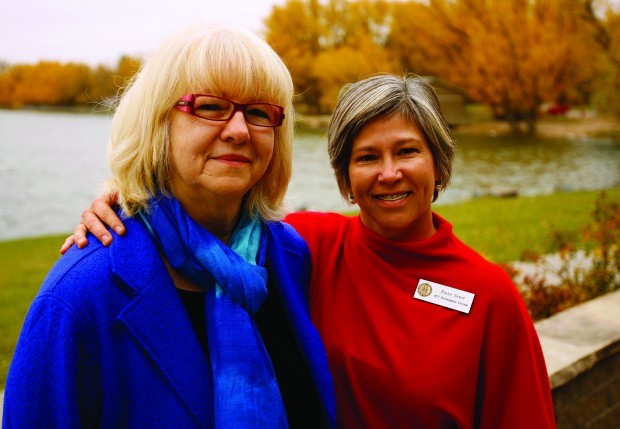
People spend more time planning their vacations than they do their retirement, Cindy Hounsell told the women who filled the Kiwanis Community House at Lions Park in Cheyenne.
Hounsell, president of the Women's Institute for Secure Retirement in Washington, D.C., presented "It's Your Financial Journey" at the Wyoming Retirement System retirement fair in October. Wyoming Retirement System, the state's retirement program, and Hounsell designed the presentation on retirement specifically for Wyoming women.
"Women live longer than men, on average, and they earn less than men, on average -- especially in Wyoming, where we have the biggest gender wage gap in the nation -- so it's harder for them to retire," said Polly Scott, communication and deferred compensation plan manager for Wyoming Retirement System. "Also, women have a pattern of taking time off from the workforce."
People are also reading…
When and how women save for retirement impacts their nest eggs. Women who do save for retirement, often start three to four years later than their male counterparts and don't save as much as them, according to the Women's Institute for Secure Retirement.
"The whole key is starting when you're young," Scott said. "Otherwise, start as soon as you're aware, because time is the best asset you have in preparing for your retirement."
There are three factors that have the greatest affect on retirement savings: life expectancy, income levels and risk tolerance. Women face unique challenges in each of these categories.
LIFE EXPECTANCY
Women generally live longer than men, so they need more money for retirement. The average woman who reaches age 65 can expect to live almost 20 more years, according to the National Retirement Resource Center. That's four more years than the average man.
The rates are similar in Wyoming. In 2009, the average woman lived to age 80 and the average man lived to age 75, according to the Wyoming Department of Health.
Those extra golden years require a lot of dough.
And many women can expect to pay for it themselves. Nationwide, nearly half of all women over age 75 live alone and likely have to support themselves, according to the Administration on Aging. For example, when one becomes a widow, pension payments may be reduced and income from Social Security may go down. Today, 40 percent of older women who live alone depend on Social Security for nearly all of their income, and more than half would be living in poverty without it, according to the Women's Institute for Secure Retirement.
INCOME LEVELS
Women tend to earn less money over the course of their lives than men, which makes it difficult to save as much -- if not more -- retirement money as them. In 2011, the median income for men was $48,202 a year while the median income for women was $37,118 nationwide, according to the American Association of University Women.
The gender wage gap also negatively affects lifetime earnings. Nationally, women earn 77 cents for every dollar men make, for a lifetime loss of $300,000, according to the Women's Institute for Secure Retirement. That loss is even greater in Wyoming, where women earn 67 cents for every dollar men earn.
Taking time off from work or reducing hours to part-time to rear children or care for aging parents or spouses also reduces women's earning potential, resulting in less retirement savings and Social Security income.
"Women, during their working lives, are paying into Social Security, but because a lot of their jobs are paying minimum wage or they left the workforce, the amount of money will not be enough," said Richelle Keinath, executive director of the Wyoming Women's Foundation, a nonprofit that gives grants to organizations that promote self-sufficiency of the state's women and girls.
RISK TOLERANCE
Recent studies show that women are much more cautious investors than men.
In a 2012 study by Prudential, 70 percent of women saw themselves as savers rather than investors and were interested only in guaranteed or FDIC-insured products. Men, on the other hand, were willing to take some risk for the opportunity of greater financial rewards.
More risk can mean more reward for investors. Avoiding risk can mean investors won’t cash in as much as they could, but may offer more security.
"Everyone really needs to look at their own situation and see how much risk they want to take," said Connie Brezik, a certified Personal Financial Specialist and president of Asset Strategies in Casper.
GETTING STARTED
While all of these disadvantages may seem daunting, there are many things you can do to prepare for retirement. First, figure out how much money you'll need for retirement. Hounsell recommends using an online calculator at www.360financialliteracy.org/tools/calculators.
"It's not something you have to do every day. It's not that hard. It's not that time consuming," Hounsell said.
Then, stay on track to meet your retirement goals with the recommendations below, from "It's Your Financial Journey."
IN YOUR 20s
Check out job benefits: Consider pension, health, retirement savings plans and other insurance in addition to your salary. You may be surprised just how valuable benefits are.
Get in the habit of saving: Open checking and savings accounts if you don't already have them. Deposit five percent of your salary into your savings account each pay period.
Start an emergency fund: Aim to save three to six months pay in case you run into emergencies such as job loss or expensive car repairs.
Start retirement saving: Sign up for your employer's retirement plan, if there is one. Contribute at least enough to get potential match money from your employer. If your employer does not have a retirement plan, open an IRA. Set up automatic monthly contributions from your checking account.
Strive for a debt-free life: While you need credit to build credit history, don't go overboard, Hounsell says. Limit yourself to one credit card for emergencies and pay the balance off each month. If you already have credit card debt, put as much money toward it as you can to pay it down. Pay down student loan debt and consider how to pay for additional education, if needed.
Start budgeting: Women who have a budget and savings plan save much more money than those who don't. Learn to make a budget and stick to it. Download one online.
IN YOUR 30s
Do an insurance checkup:
- If you've started a family, buy life insurance that will protect them financially if you die.
- Make sure your health insurance is meeting your needs.
- Consider disability insurance, if you don't already have it.
- Make sure you're covered by enough home or car insurance.
- If you rent your home, get rental insurance to cover losses such as fire or theft.
Keep saving and focus more on investing: Learn about investing and make sure your retirement assets meet your needs. For example, if you are in a target date fund, make sure it suits your time frame, Scott said.
IN YOUR 40s
Review your investments: Look at how you are investing and ask for professional help, if needed. You still, potentially, have many years to retirement and could take advantage of growth-type investments, such as mutual funds.
Consider hiring a financial adviser: A good financial planning professional -- such as a licensed broker -- can set and keep you on track to meet your goals.
IN YOUR 50s
Take advantage of catch-up opportunities: If you have a defined contribution plan, such as a 401K or IRA, you may be able to make catch-up contributions starting at age 50. Check your plan to learn more.
Learn about payout options: Consider when to take payout options or claim Social Security. It is not a decision that should be taken lightly.
IN YOUR 60s
Consider healthcare costs: Apply for Medicare three months before you turn 65. You may find that your employer health care combined with Medicare makes it worth staying in your job a few more years.
Consider working longer: If you can't afford to retire, consider your options for continuing to work full or part-time. You can hold off collecting on your Social Security benefit up to age 70 to increase your monthly payment. Also consider what other benefits you might be eligible for to help with costs.
IN YOUR 70s
Start required minimum distributions: If you have a traditional IRA that you haven't taken withdrawals from yet, you must start taking money out after age 70.5, otherwise you might get hit with a big tax penalty. Other retirement plans may have similar penalties. Start collecting Social Security at age 70 if you've delayed your benefit.
Re-evaluate your spending strategy: Find out what you need to do to make your retirement funds last.
This article is for informational purposes only. Please consult your financial adviser for more information.
Carol Seavey is editor of Live Well Wyoming. Contact her at 307-266-0544 or carol.seavey@trib.com. Follow her on twitter at Carol_Seavey.
"Women live longer than men, on average, and they earn less than men, on average -- especially in Wyoming, where we have the biggest gender wage gap in the nation -- so it's harder for them to retire." -- Polly Scott, Wyoming Retirement System communication and deferred compensation plan manager for