


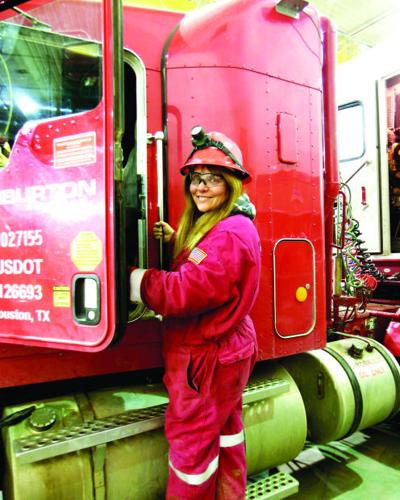
Dottie Nobles never thought she’d earn more than $50,000 a year.
After a divorce, the Green River woman struggled to earn enough money working as a courier to support herself, her three children and a child she had taken in. So, when she heard the energy industry was hiring, she applied and was hired on the spot.
“Although I was working 60 to 80 hours a week as a courier, I tripled my wages,” Nobles said.
That was nine years ago. Since then, she has worked her way up to lab analyst at FMC in Green River, where trona is manufactured into soda ash products.
By changing careers, she increased her earning potential. It’s one of two things women can do to increase their pay: choose a higher-paying career or get more education.
In 2012, women working fulltime, year-round earned 77 percent of what men were paid, according to the American Association of University Women. It recently reported that women in Wyoming earn 64 percent of what their male counterparts earned that same year.
People are also reading…
“Because of sex segregation, the jobs at higher pay that don’t take higher education are more readily occupied by men,” said Richelle Keinath, executive director of the Wyoming Women’s Foundation, a nonprofit organization that promotes self-sufficiency for women and girls.
Women tend to work in “women’s” jobs, such as social work, nursing and teaching, while men usually work in traditionally male fields, such as computer programming, engineering and firefighting, according to “The Status of Wyoming’s Working Women: 2011” by Catherine Connolly, professor of gender and women’s studies at the University of Wyoming.
About half of women who work in Wyoming are employed in fields such as health care, education and leisure. These fields tend to pay less than those traditionally filled by men, such as mining.
Nontraditional jobs
Few women work in the energy industry. In 2012, 29,962 men worked in natural resources and mining industries in Wyoming, according to the Wyoming Department of Workforce Services. That same year, only 4,193 women worked in the energy industry and those who did earned, on average, $21,543 less than their male counterparts.
“We’re very gender diverse in support functions, but when it comes to science, technology, engineering and math, we — along with others in the industry — struggle with having the best gender diversity that we can,” said Cindy Bigner, senior director of corporate affairs and diversity initiatives for Halliburton in Houston.
That gap is due to women choosing administrative roles, she added. While there are plenty of indoor jobs, some positions in the energy industry require people to work outside in the elements, long hours, swing shifts or out-of-town, which can hinder those who care for children or aging parents.
“If you’ve got children or care for older parents, you need more flexibility in your work,” Keinath said, adding that those responsibilities often fall on women.
Nobles was fortunate to have the support of her second husband when her now-grown kids were still at home. While she worked, he took care of things at home.
“If he weren’t helping me, this probably wouldn’t be possible,” she said. “You have to make a plan and be willing to change your attitude and, sometimes, your belief system.”
Sabrina Dona, of Rock Springs, didn’t have any trouble accommodating her 60-hour workweek when her children were still in school. She started as a frack administrator eight years ago, traveling with frack crews and doing paperwork. Once she became familiar with fracking, she decided she wanted to join the frack crew. Dona earned her CDL license and did company training with Halliburton. Now, she’s an operator assistant in fracking.
She enjoys the rapport she has with the men on her crew.
“It’s like having a whole crew full of brothers, you know?” Dona said. “They were probably my biggest supporters for swapping over for learning stuff and quizzing me on things.”
Dona hopes to someday be in a position where she can train others, and with the training and advancement opportunities available to her, that’s a realistic goal.
“Halliburton in general has been really supportive of me and my crew,” she said. “They really strive to push me to do better, and it really helps to know you have that backing from your employer.”
STEM
Getting women into science, technology, engineering and math positions starts with education.
In Wyoming, about 61 percent of men and 38 percent of women majored in fields related to science, technology, engineering and math in 2009, according to “The Status of Wyoming’s Working Women: 2011.”
“We have to get there through the K-12 organizations and try to encourage women to go into STEM, and encourage our government to encourage funding for STEM,” Bigner said. “There’s not enough women going into those fields. It starts in the beginning and it starts in high school — we all have a part to play in this.”
Halliburton works with colleges and other organizations to help provide STEM education to women. It’s part of a larger movement to encourage girls to pursue the typically male-dominated fields.
“Sometimes girls think that it’s not cool or girly to go into STEM,” said Rebekah Smith, program coordinator for the Wyoming Women’s Foundation.
Oftentimes, girls start to lose interest in STEM fields in late elementary school, she added. Part of the challenge is changing the girls’ perception of who works in STEM, Smith said. One way to do that is to through mentoring.
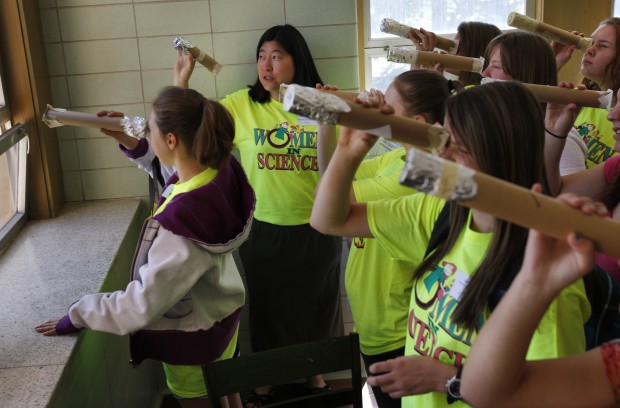
For example, the Women in Science conference allows girls in grades seven through 12 to meet professors and scientists and learn about careers available in STEM. It is held annually at the University of Wyoming in Laramie.
EDUCATION
Despite the field of study, further education has a positive impact on women’s wages.
“Education is a key factor for women in Wyoming, even more so than it is for men,” said Catherine Connolly, professor of gender and women’s studies at the University of Wyoming.
Nationwide, the average woman has to have some college education in order to surpass the earnings of male high school drop outs, according to the National Law Center. The average male high school dropout earns $24,689 while the average female with some college education earns $26,513.
The gender wage gap is greatest among high school dropouts. In 2012, the wage gap between male and female high school dropouts in Wyoming was 60 percent, Connolly said.
Women can expect to earn wages closer to those of their male counterparts with each educational milestone they pass.
In Wyoming, women earn less with a bachelors degree than men earn with a high school diploma, according to Connolly’s 2011 report. Women with bachelors degrees earned an average of $35,634, while men with high school diplomas earned an average $38,153. With a bachelors degree, the men earned $50,842.
It’s not until women complete the highest degrees that the gender wage gap starts to close.
Carol Seavey is editor of Live Well Wyoming. Contact her at 307-266-0544 or carol.seavey@trib.com. Follow her on twitter at Carol_Seavey.


